

Blog
Vitamin D and Calcium Deficiency in Desk Job Workers: Why Your Office Routine Is Weakening Your Bones


If you spend most of your day at a desk, under fluorescent lights, moving between your car and your office, your bones may be paying a quiet price. Long hours indoors cut off the one trigger your skin needs to make vitamin D naturally: direct sunlight. Without enough vitamin D, your body cannot absorb calcium properly, even if your diet is otherwise healthy. Over months and years, this combination can weaken bone density and set the stage for chronic aches, fatigue, and fractures later in life.
This article breaks down why desk-based work is a specific risk factor for a combined vitamin D and calcium deficiency, how to recognize the early signs, and what you can do about it starting today.
How a Desk Job Quietly Drains Your Vitamin D and Calcium Levels
Your skin produces vitamin D when it is exposed to ultraviolet B rays from sunlight. Office workers who arrive before sunrise, sit indoors all day, and leave after sunset often get little to no meaningful sun exposure during the week. Add air-conditioned buildings, tinted car windows, and a desk positioned away from natural light, and the problem compounds.
According to the National Institutes of Health Office of Dietary Supplements, vitamin D helps your body absorb calcium, one of the main building blocks for strong bones, and together the two nutrients help protect against osteoporosis later in life.
Calcium depends on vitamin D to be absorbed in the gut. Without adequate vitamin D, most of the calcium in your diet or supplements simply passes through your system unused. This is why a desk-based lifestyle rarely causes just one deficiency. It usually causes both at once, and the two problems reinforce each other.
Signs You May Have a Vitamin D and Calcium Deficiency
The early symptoms are easy to dismiss as ordinary work fatigue. Watch for the following:
- Persistent tiredness that does not improve with sleep or coffee
- Dull lower back pain or aching hips after long periods of sitting
- Frequent muscle cramps, especially in the legs and feet
- Joint stiffness when standing up after sitting for hours
- Brittle nails or slow-healing minor injuries
- Low mood or difficulty concentrating during long work sessions
None of these symptoms confirm a deficiency on their own. A simple blood test for 25-hydroxyvitamin D, ordered by your doctor, is the only reliable way to know your actual levels.
Why Desk-Based Professionals Are a Distinct Risk Group
Mayo Clinic notes that people who spend most of their time indoors generally have low levels of vitamin D, and this risk applies regardless of age or overall health. Desk workers rarely fit the profile most people associate with deficiency, such as older adults or those with digestive disorders. Yet the daily pattern of commuting in a car, working under artificial light, and eating lunch at a desk creates the same low-sun-exposure conditions that drive deficiency in higher-risk groups.
For professionals in Pakistan working long shifts in offices, call centers, banks, or IT parks, this risk is often overlooked because sunlight feels abundant outside. The problem is not the weather. It is the lack of direct, unfiltered skin exposure during work hours.
How Vitamin D and Calcium Work Together for Bone Strength
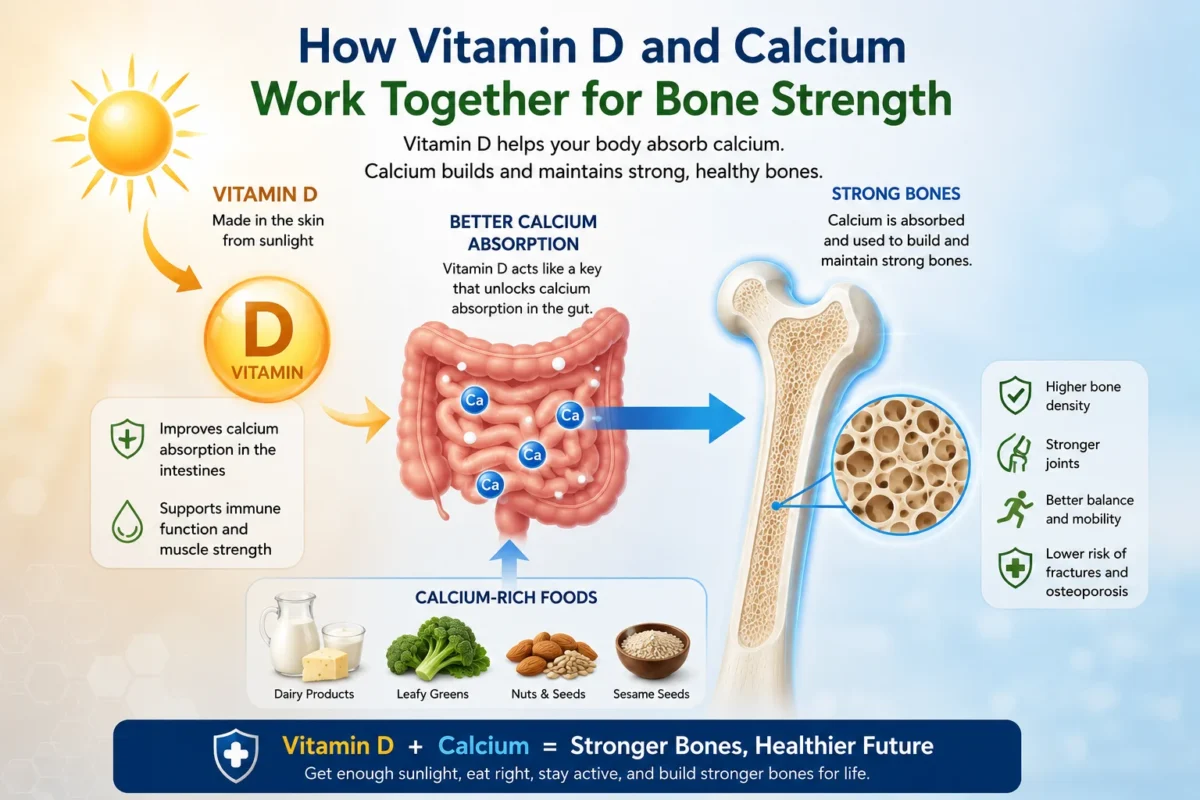
Bone is living tissue that constantly rebuilds itself. Calcium supplies the structural mineral, while vitamin D acts as the gatekeeper that lets your intestines absorb that calcium into the bloodstream. When vitamin D is low, your body responds by pulling calcium out of your bones to keep blood calcium levels stable. Over time, this trade-off leaves bones thinner and more fragile, even if your calcium intake looks adequate on paper.
This is why nutrition guidance almost always addresses both nutrients together rather than in isolation. Correcting a vitamin D deficiency without adequate calcium intake, or the reverse, leaves the underlying bone health problem only half solved.
Daily Habits That Protect Your Bones at a Desk Job
1. Reclaim a Few Minutes of Real Sunlight
Step outside during a tea break or lunch hour, ideally between mid-morning and early afternoon, with your forearms and face uncovered for ten to fifteen minutes. Even short, regular exposure adds up over a work week.
2. Rethink Your Desk Lunch
Add calcium-rich foods such as dairy, fortified plant milk, sesame seeds, and leafy greens to your regular lunch rotation. Pair them with a source of healthy fat, since vitamin D is fat-soluble and absorbs better alongside food.
3. Move Every Hour
Short walks around the office support circulation and bone loading, which helps maintain bone density independently of nutrient intake.
4. Consider a Calcium Citrate Supplement
If your blood work confirms low levels, or your diet consistently falls short, a bioavailable supplement can help close the gap. Nutriful Caldrion Calcium Citrate is formulated as calcium citrate, a form that does not require stomach acid for absorption, making it a practical option for people who take it with or without food during a busy workday.
Recommended Daily Intake by Age Group
| Age Group | Calcium (mg/day) | Vitamin D (IU/day) |
| 19–50 years | 1,000 mg | 600 IU |
| 51–70 years (men) | 1,000 mg | 600–800 IU |
| 51–70 years (women) | 1,200 mg | 600–800 IU |
| 71+ years | 1,200 mg | 800 IU |
These figures are general population guidelines. Your doctor may recommend different amounts based on your blood test results, existing health conditions, or medications.
When to See a Doctor
Book a checkup if fatigue, bone pain, or muscle cramps persist for more than a few weeks despite adequate rest, or if you notice frequent fractures from minor falls or bumps. A doctor can order a blood test, review your medication list for interactions, and recommend a supplement dose suited to your specific levels rather than a generic one.
Frequently Asked Questions
Can I get enough vitamin D from a short walk during lunch?
A short walk helps, but factors like cloud cover, pollution, sunscreen, and how much skin is exposed all affect how much vitamin D your body actually produces. It is a useful habit, not a guaranteed fix.
Is it safe to take calcium and vitamin D supplements together?
For most healthy adults, yes. Vitamin D actually improves how well calcium is absorbed, so the two are commonly recommended as a pair. Check with your doctor if you take other medications, since calcium can interact with certain antibiotics and thyroid medicines.
How long does it take to correct a deficiency?
Most people see blood levels improve within eight to twelve weeks of consistent supplementation and better sun exposure, though bone density changes take longer to show up on scans.
Does working from home solve this problem?
Not automatically. Many remote workers spend even less time outdoors than commuting office employees. The fix is intentional sun exposure and nutrition, not the location of your desk.
Can screen time or blue light affect vitamin D levels?
No. Vitamin D production depends specifically on UVB rays from sunlight. Screens and indoor lighting do not produce the wavelength your skin needs.
Why is calcium citrate recommended over other forms of calcium?
Calcium citrate does not need stomach acid to be absorbed, which makes it gentler on digestion and suitable for people who take it on an empty stomach or have lower stomach acid levels, a common issue among older adults and desk workers who skip meals.
Key Takeaway
A desk job does not cause vitamin D and calcium deficiency on its own, but the daily pattern of indoor hours, long commutes, and rushed meals creates the exact conditions that lead to it. A combination of brief, intentional sun exposure, a calcium-conscious diet, and a bioavailable supplement when needed can protect your bone health for the decades you will spend at that desk.