
Blog
Collagen Type I vs. Type III: Which Is Better for Joints?


Collagen supplements are everywhere. But most buyers don’t realise “collagen” isn’t one single ingredient. Your body has at least 28 identified types, and the type you take actually matters for your results. If you’ve been staring at a label wondering whether Type I, Type III, or a blend is right for your joints, here’s what the research actually says.
Why Collagen Type Matters in the First Place
Collagen is the most abundant protein in your body. It forms the structural scaffolding of your skin, bones, tendons, ligaments, and cartilage. But different tissues rely on different collagen types in different ratios. Buying a generic “collagen supplement” without knowing its type is a bit like buying a multivitamin without checking which vitamins it contains. The label alone won’t tell you what it actually supports.
What Type I Collagen Does
Type I makes up roughly 90% of your body’s collagen. It packs densely and gives structural support to your skin, bones, tendons, and ligaments. Researchers link it most closely to skin elasticity and anti-aging benefits. But your tendons and ligaments — the key connective structures around your joints — also depend heavily on it for tensile strength and resilience under load.
What Type III Collagen Does
Type III typically sits alongside Type I in your skin, blood vessels, and muscles. It supports tissue repair, vascular integrity, and skin elasticity. It generally works in tandem with Type I rather than as a standalone joint-specific ingredient. That’s why most commercial supplements pair the two together instead of selling Type III on its own.
What the Research Actually Shows
A literature review covering collagen supplementation for skin and orthopedic conditions found that oral hydrolyzed collagen consistently increases skin elasticity, hydration, and collagen density. It also improves wound healing and helps protect skin against visible aging. Researchers saw these effects across multiple randomized clinical trials, not just one isolated study.
For joints specifically, a systematic review focused on Type I collagen hydrolysate found that collagen peptides offer meaningfully higher digestibility and absorption than undenatured collagen. Why? The hydrolysis process breaks the protein down into low molecular weight peptides your body can actually use. That’s a key reason why “hydrolyzed” or “peptide” collagen on a label matters more than the raw type number alone.
Is Type I/III the Right Choice for Joint Pain, or Should You Look at Type II?
This is where a lot of marketing gets muddled. Strictly speaking, cartilage — the tissue most directly involved in joint pain and osteoarthritis — is primarily built from Type II collagen, not Type I or III. The Arthritis Foundation reports that collagen supplements, particularly undenatured Type II collagen (UC-II), show some promise for reducing joint pain and stiffness in people with osteoarthritis. Still, researchers consider the overall evidence moderate rather than definitive.
That doesn’t make Type I/III collagen irrelevant to joint health, though. Tendons and ligaments — the connective tissue that stabilizes your joints from the outside — are largely Type I structures. Supplying the amino acid building blocks they need (glycine, proline, hydroxyproline) can support their repair and resilience. The effect on cartilage itself is more indirect than a Type II-specific product. But the joint-support role is still real.
Type I/III vs. Type II: A Practical Comparison
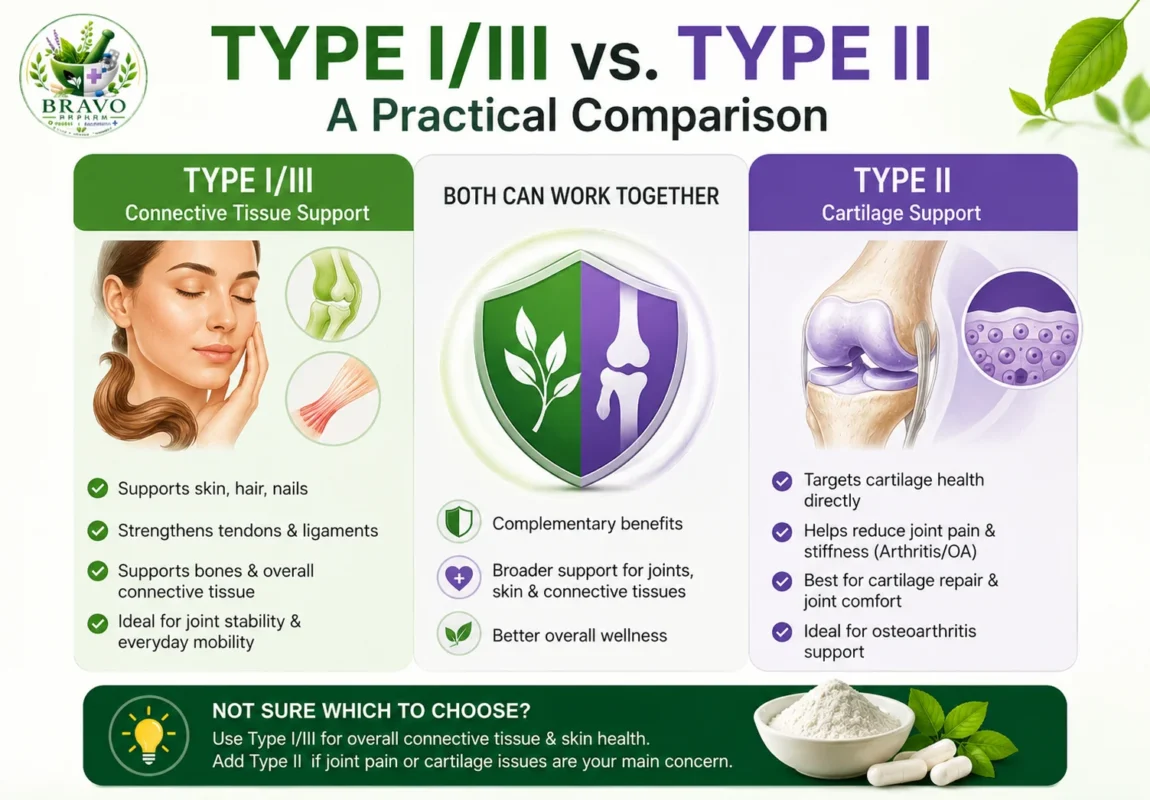
- Want skin, hair, nail, and general connective-tissue support: choose Type I/III blends. They have the strongest supporting evidence of any collagen category.
- Want targeted cartilage support for arthritis-type joint pain: choose Type II, often as undenatured UC-II, which has more cartilage-specific evidence behind it.
- Want support for tendons and ligaments rather than cartilage itself: Type I/III still matters. These tissues are structurally built from Type I collagen.
- Not sure which you need: try Type I/III first for skin and connective tissue support. Add Type II later if cartilage-specific joint pain remains your main concern.
Does the Source of Collagen (Bovine, Marine, Porcine) Matter?
Manufacturers typically source commercial collagen peptides from bovine hide, porcine skin, or fish scales and fins. Research suggests marine-sourced collagen peptides share a structure and bioavailability quite similar to human collagen. That’s part of why fish-derived collagen has become popular in newer formulations. In practice, molecular weight and processing quality tend to matter more for absorption than the animal source alone. Look for products that specify low molecular weight, hydrolyzed peptides rather than relying on source as your only quality signal.
How Bravo Pharma’s Cello-B Fits In
Bravo Pharma’s Nutriful Cello-B collagen tablets combine Type I and Type III collagen with biotin. This formula supports skin, hair, and general connective tissue health together, rather than isolating a single benefit. The blend reflects how Type I and III naturally work alongside each other in your body.
How Long Before You See Results?
Collagen research consistently shows effects building gradually, not appearing within days. Most clinical trials measuring skin hydration and elasticity ran for 8 to 12 weeks of daily use before showing real improvement. Joint-related benefits generally follow a similar or slightly longer timeline. Stop after two or three weeks with no visible change? You likely haven’t given it enough time to work.
Dosage and Practical Tips
- Most clinical trials use daily doses between 2.5 and 15 grams of hydrolyzed collagen peptides. The exact amount depends on the outcome researchers measured.
- Take it at any time of day, with or without food — consistency matters more than timing.
- Pair collagen with vitamin C-rich foods. Vitamin C acts as a required cofactor for your body’s own natural collagen synthesis.
- If joint pain is your main concern, watch for improvement over 12 weeks of Type I/III collagen. No change? Try a Type II-specific product instead, or talk to a doctor about persistent joint pain.
Common Myths About Collagen Supplements
- “Eating collagen directly rebuilds your cartilage” — not quite. Your body breaks ingested collagen down into amino acids and peptides during digestion; it doesn’t travel intact to your joints. Instead, these building blocks appear to stimulate your own cells to produce more collagen — an indirect but still meaningful mechanism.
- “All collagen supplements are the same” — false. Molecular weight, hydrolysis quality, and collagen type all affect how well your body absorbs a product and what it actually supports. Two products both labeled “collagen” can perform very differently in practice.
- “You need a huge dose for it to work” — not necessarily. Most clinical trials showing meaningful results used daily doses well under 15 grams. An extremely high-dose product isn’t automatically more effective than a well-formulated moderate dose.
Who Should Be Cautious
Most people tolerate collagen supplements well. Still, check the source carefully if you have a fish or shellfish allergy and you’re considering a marine-derived collagen product. Follow a strict vegetarian or vegan diet? Note that all current commercial collagen comes from animal sources. There’s no true plant-based collagen protein yet. If you’re pregnant, breastfeeding, or managing a chronic health condition, check with your doctor before adding any new supplement, even a generally low-risk one like collagen.
Quick FAQ
Can I take Type I/III and Type II collagen together?
Yes — researchers know of no conflict between them. Some people use both for broader coverage of skin, connective tissue, and cartilage support.
Is collagen safe to take long-term?
Generally yes, for most healthy adults. It’s a well-tolerated supplement with a strong safety record across the clinical trials reviewed.
Does iron or vitamin absorption interact with collagen supplements?
Researchers haven’t identified a significant interaction. But if you manage multiple supplements, check our guide on iron bisglycinate vs. ferrous sulfate. It covers general principles for spacing supplements to improve absorption, which apply broadly to most mineral and protein supplements taken together.
This article is educational and not a substitute for medical advice. If you have osteoarthritis or a diagnosed joint condition, discuss supplement choices with your doctor before starting a new regimen.