
Blog
Best Time to Take Iron Tablets If You Work Night Shifts

Night shift work already throws off your sleep. It disrupts your appetite too. It drains your energy levels. Add an iron supplement into that mix, and timing questions get complicated fast. Here’s what current research actually suggests about when to take iron if you work nights.
Why Night Shift Work Changes the Timing Question
Your body runs on more than one internal clock. The main clock sits in your brain. It follows light and darkness. But your liver, gut, and other organs run their own local clocks too. These local clocks tune themselves to when you normally eat and sleep. Night shift work throws these clocks out of sync with each other. That’s part of why shift workers report more digestive issues, fatigue, and metabolic problems than day workers.
What the Circadian Research on Iron Actually Found
A University of Utah study found something striking. Dietary iron plays a direct role in setting the circadian clock inside your liver. The lead researcher called iron “the dial that sets the timing of the clock.” Eating iron at the wrong time can throw that dial off. If iron intake happens out of sync with your body’s main clock — during a graveyard shift, for example — it may worsen the mismatch between your liver’s clock and your brain’s clock. Researchers linked this kind of mismatch to abnormal blood sugar regulation over time.
This research focused on dietary iron, not supplement timing specifically. The study’s own authors said more research is still needed. But the underlying principle likely applies to supplements too. Taking iron at a time your body doesn’t expect food may add to the circadian disruption shift work already causes.
What Shift-Work Nutrition Guidelines Recommend
The U.S. CDC’s NIOSH shift-work training modules offer general diet guidance for night shift workers. This guidance builds on research by sleep scientist Arne Lowden and colleagues. The core recommendation is simple: avoid eating, or reduce food intake, between midnight and 6 a.m. Follow your body’s normal day-and-night meal pattern as closely as your shift allows. Don’t eat a full dinner-sized meal in the middle of the night.
The same NIOSH guidance also flags another detail. Avoid large meals in the one to two hours before your main sleep period, whatever time that falls at for you. This matters directly for iron timing. Taking iron tablets with a large meal right before sleep works against this broader shift-work nutrition principle.
A Practical Timing Approach for Night Shift Workers

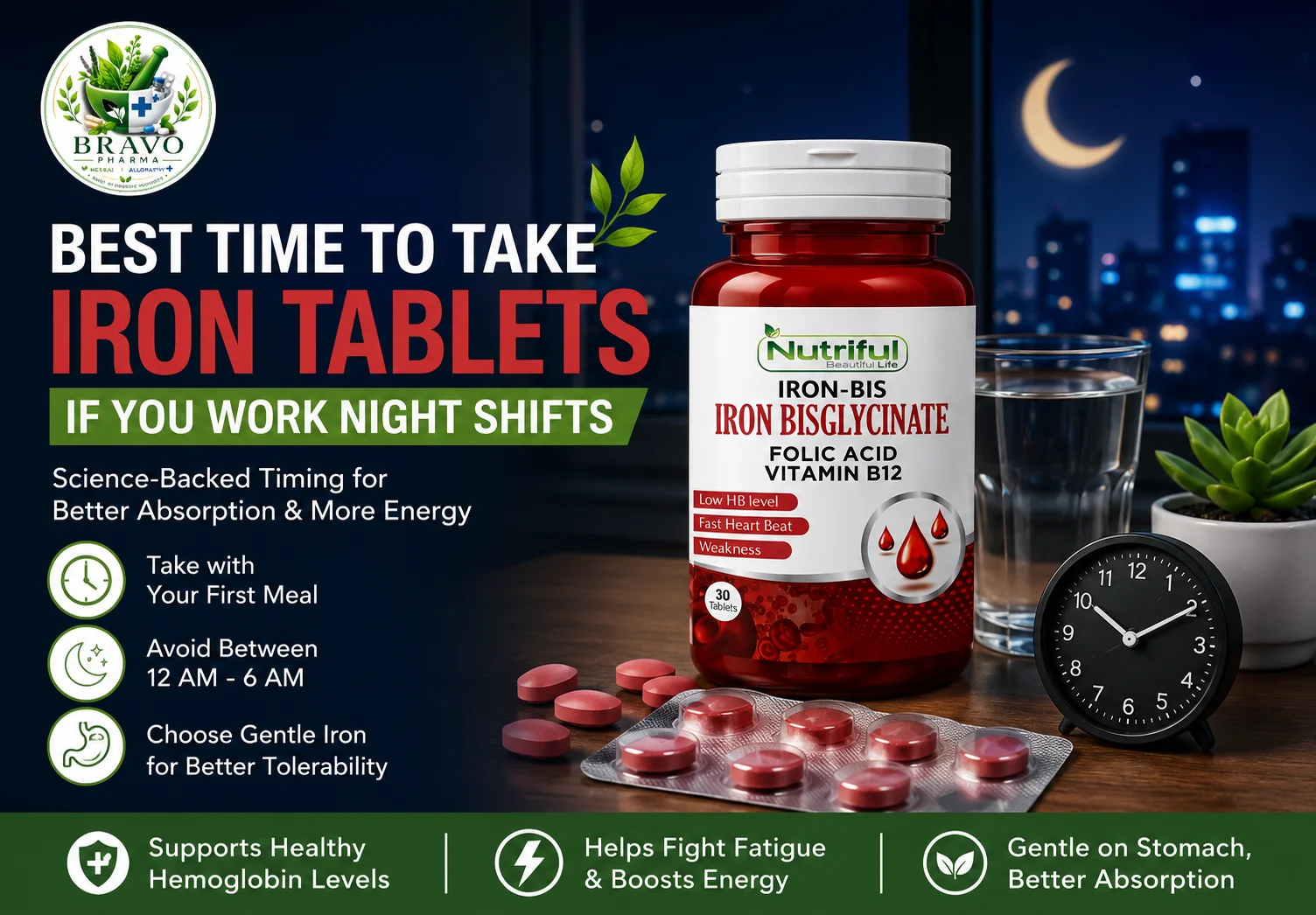
- Take iron with your first meal of your “day.” This applies even if that meal happens in the evening, right before your shift starts.
- Avoid taking iron between midnight and 6 a.m. This lines up with the general shift-work eating guidance above.
- Skip pairing iron with your pre-sleep meal. Large meals close to sleep already work against your body’s rhythm.
- Keep the same iron timing every working day, even on days off. Your body shouldn’t have to adjust to a shifting schedule on top of shift work itself.
Don’t Forget the Basic Absorption Rules
Whatever time you choose, standard iron absorption rules still apply. Keep iron away from calcium, tea, and coffee. Separate it by at least two hours from medications like thyroid hormone.
Our guide on iron bisglycinate vs. ferrous sulfate covers these absorption basics in more depth. It also explains which iron form tends to sit easier on a stomach already dealing with shift-work-related digestive stress.
Why Night Shift Workers Face Higher Iron Deficiency Risk
Shift work disrupts appetite regulation. It often pushes people toward convenience food over iron-rich meals. Add disrupted sleep on top of that. Poor sleep itself affects how your body regulates iron storage hormones. Put these factors together, and night shift workers face a genuinely higher practical risk of falling short on iron than day workers eating on a regular schedule.
The GI Symptom Overlap Worth Knowing About
Shift work on its own raises the risk of gastrointestinal symptoms, since eating against your body’s natural rhythm strains digestion. Iron supplements, especially standard ferrous sulfate, can add their own stomach upset on top of that. This overlap is exactly why the iron form you choose matters more for shift workers than for people on a regular daytime schedule.
Gentler Iron Options Matter More for Shift Workers
Shift work already strains digestion. Standard ferrous sulfate iron tablets carry a higher risk of constipation and nausea. That risk becomes more disruptive when you’re also managing shift-related stomach issues.
Bravo Pharma’s Iron-Bis iron bisglycinate tablets use a gentler, chelated iron form. This form specifically aims to reduce stomach upset. That may make consistent daily use easier for shift workers already managing a demanding schedule.
Building a Simple Routine Around Your Shift Pattern
- Rotating shifts: anchor iron to your first meal each day, not a fixed clock time, since your “morning” keeps shifting.
- Fixed night shifts: pick one consistent meal, ideally your pre-shift meal, and take iron with it every working day.
- Days off: keep the same timing pattern rather than switching back to a daytime schedule and then switching again.
Consistency matters more than the exact clock time you choose. A predictable routine helps your body adjust, even around an unpredictable work schedule.
Signs You Might Need Iron Testing, Not Just a Supplement
- Persistent fatigue that doesn’t improve even after adequate sleep
- Shortness of breath during normal daily activity
- Pale skin, brittle nails, or unusual food cravings like ice
- Difficulty concentrating that goes beyond normal shift-work tiredness
Shift work fatigue and iron deficiency fatigue can look nearly identical. A simple blood test tells you which one you’re actually dealing with. Don’t rely on guesswork based on symptoms alone.
Why This Question Rarely Gets a Straight Answer Online
Search for iron supplement timing, and most results assume a standard 9-to-5 schedule. They mention “morning” or “with breakfast” without ever addressing what that means for someone whose “morning” starts at 7 p.m. This gap in general health advice is exactly why shift workers end up guessing, often defaulting to whatever timing feels convenient rather than what actually works with their body’s rhythm.
Common Myths About Iron and Night Shift Work
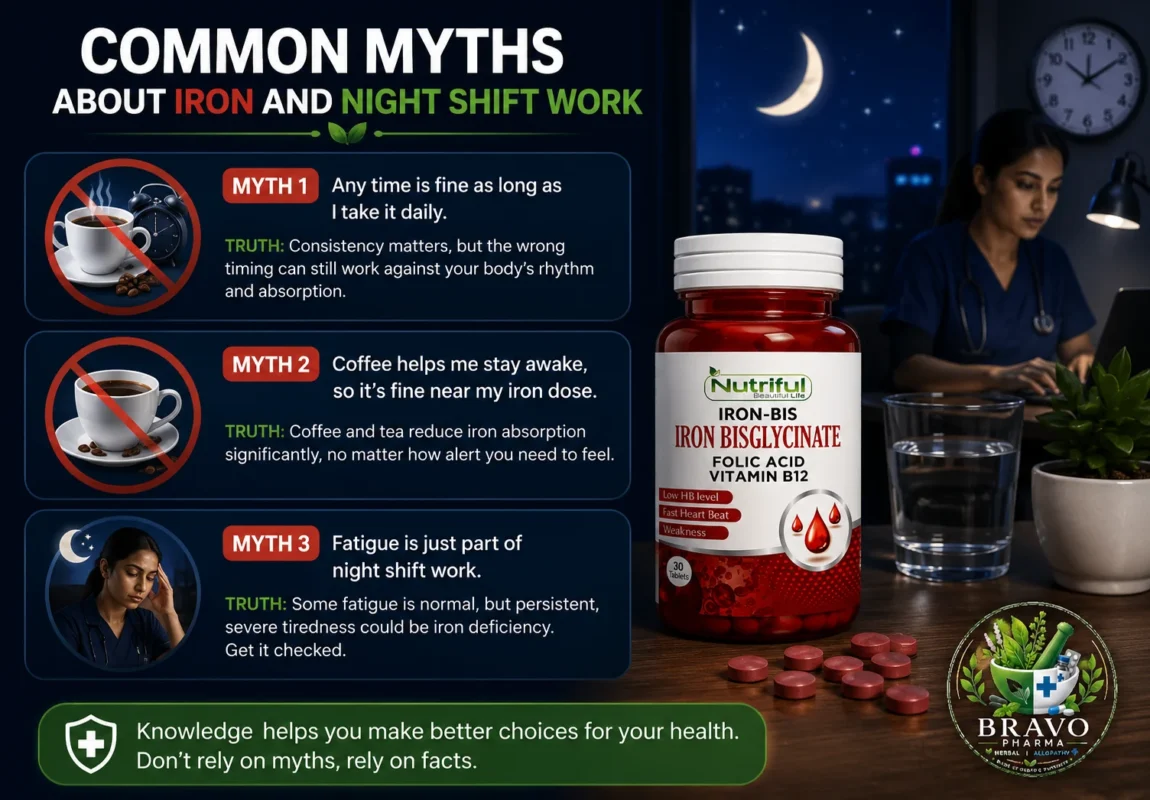
- “Any time is fine as long as I take it daily” — not quite. Consistency matters, but pairing iron with the wrong meal timing can still work against your body’s rhythm, even with perfect daily adherence.
- “Coffee helps me stay awake, so it’s fine near my iron dose” — not accurate. Coffee and tea both reduce iron absorption significantly, regardless of how alert you need to feel.
- “Fatigue is just part of night shift work” — partly true, but persistent, severe fatigue deserves a proper check. Don’t automatically write it off as normal shift tiredness.
The Takeaway
Night shift work adds real complexity to iron supplement timing, mostly because your body’s internal clocks aren’t running in sync with a normal day. Anchor your iron dose to your first meal each working day. Avoid the midnight-to-6-a.m. window when possible. Choose a gentler iron form if shift work already strains your digestion. And if fatigue persists despite consistent supplementation, a simple blood test is worth the conversation with your doctor.
Quick FAQ
Should I take iron before or after my night shift?
Take it with your first meal of the day, whenever that falls for your schedule. Avoid taking it in the middle of your shift itself.
Does rotating between day and night shifts change this advice?
Yes. Keep iron timing anchored to your first meal each day, even as your schedule rotates, rather than a fixed clock time.
Can shift work alone cause iron deficiency?
Not directly. But disrupted eating patterns and appetite changes common in shift work can make it harder to get enough iron from diet alone.
This article is for general educational purposes and is not a substitute for medical advice. If you suspect iron deficiency, consult your doctor for proper testing before starting supplementation, especially if you have a chronic condition or take other medications.